
Start with Intent: The First Rule of Prompting
The Architecture of Intent: Why Precise Language is the New Corporate Currency
The invisible cost of “Help with this”
They tried it at a bank in Australia and it was a total disaster. According to the case study in Precision Prompting, the bank replaced its call centre staff with an AI system to save money, but all they got was a wave of angry customers. Within weeks, they were frantically rehiring the people they had just let go.
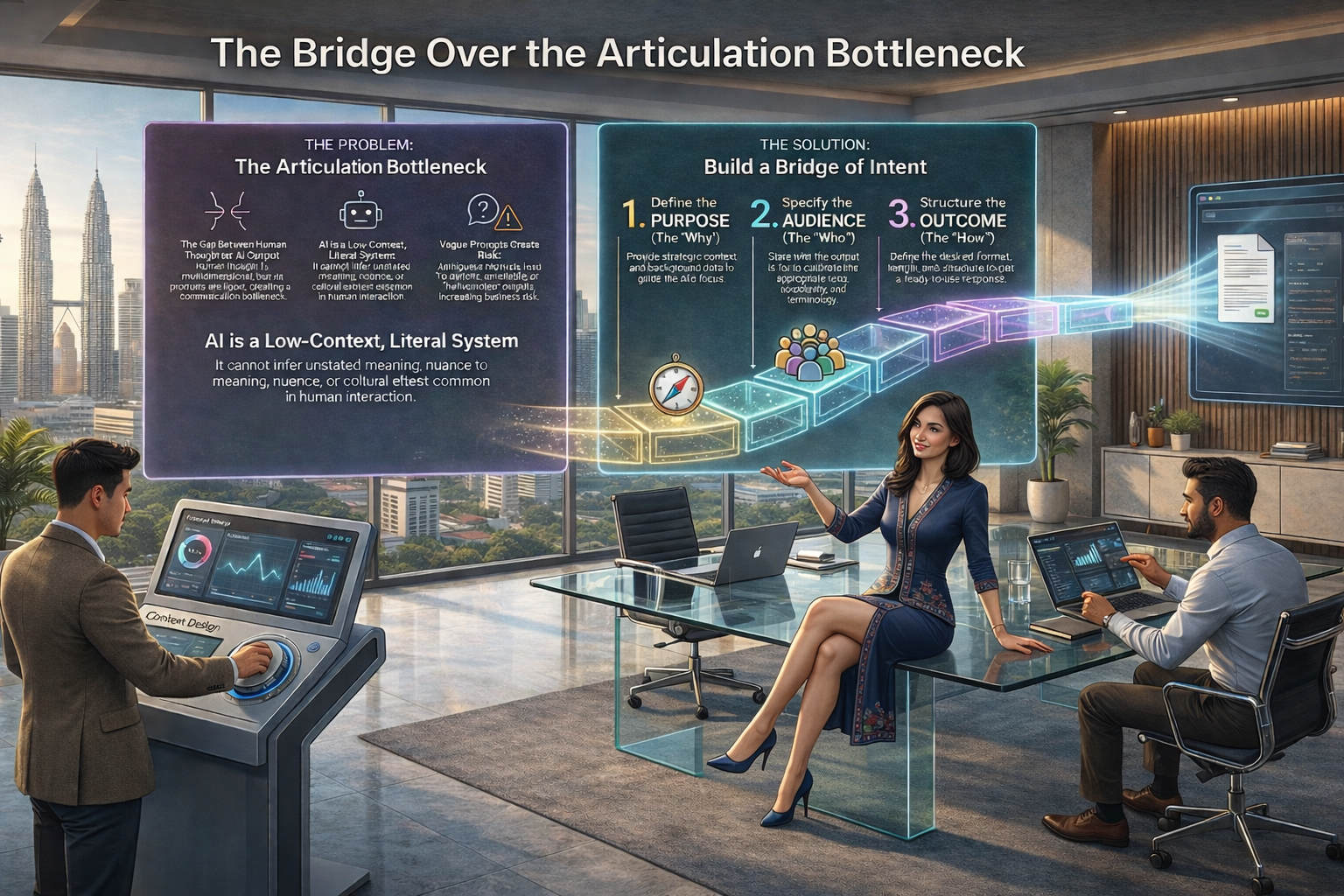
This story is a warning for all of us because it exposes what The Architecture of Intent research calls the “articulation bottleneck.” It is that frustrating gap between our complex thoughts and the literal text we type
We are currently stuck in a bit of a transition. While we feel the pressure to use these tools, the latest industry figures show that only about 23% of Malaysian CEOs are actually ready to weave AI into their workforce. We often treat the machine like a person who can read between the lines, but the sources are clear: it cannot.
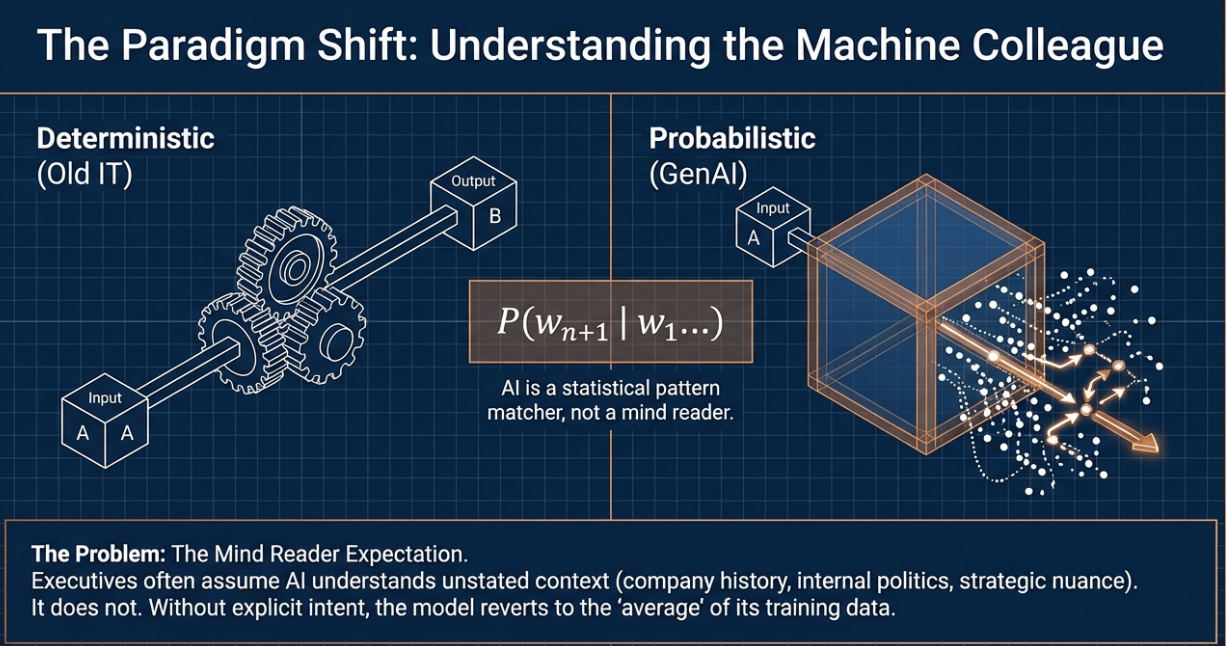
When we give a vague request, we are just asking a statistical engine to guess the next word based on probability. If our input is generic, the output will almost certainly be a “hallucination” or just a boring average of the internet.
My framework for strategic grounding
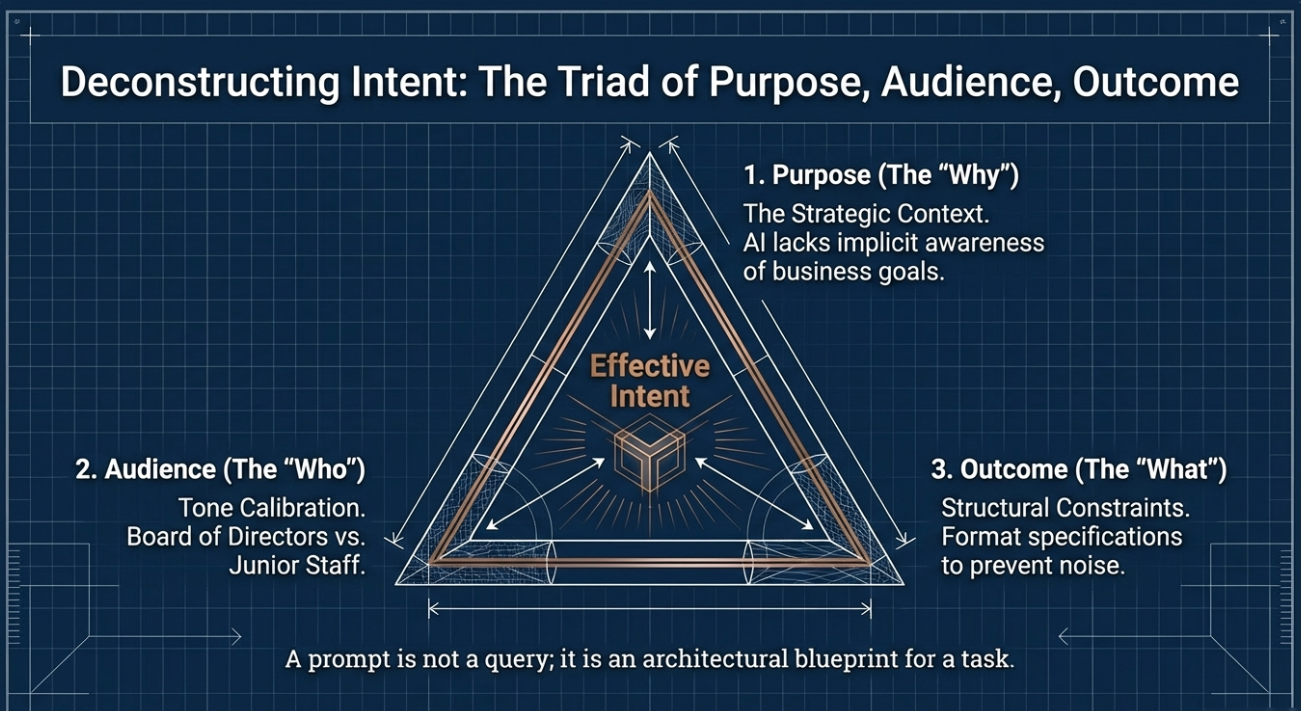
In my own practice, the only way I have found to bridge this gap is through what the experts call “Context Design.” Drawing on the strategic triad of purpose, audience, and outcome, I have found that you must ground every task in the “why” before you get to the “how.”
When I draft a prompt, I make sure to explicitly mention how it fits into our local reality, specifically aligning it with the Malaysia National AI Roadmap. I have seen that specifying the audience is the most neglected part of the process.
My experience shows that writing for a board of directors requires a totally different tone than a briefing note for a clerk.
Following the cognitive science mentioned in the Precision Prompting guide, I always define the format early, asking for a Markdown table or a bulleted list, because it actually helps my own brain focus. It stops that “kitchen sink approach” where the AI just dumps a pile of useless noise on my desk.
Why your manners might be breaking the machine
You know exactly how it feels to navigate a Malaysian office. You rely on tact and diplomacy to keep things moving. You might say “yes” when you really mean “no” just to save face or keep the peace.
In your human team, this is a social lubricant, but the research in The Architecture of Intent warns that this is a “psychological trap.” You have to realise that AI is a “low-context” system. It does not see your nods, your silences, or the history of your relationships. It only understands the literal, explicit content of your message. If you are too polite or indirect, the machine interprets that as a lack of specific constraints.
To get the best results, you need to get over the “Mind Reader Expectation.” You have to stop expecting the tool to “read the air” and start giving it the blunt, command-oriented instructions it needs to function.
I take the lead, and so should you
I believe that prompting is a form of professional delegation, not abdication. I take full accountability for what the machine produces, because as the legal analysis in The Architecture of Intent points out, Malaysian directors remain liable for decisions even when they are informed by AI.
You cannot blame the tool when things go wrong in the boardroom. To stay safe, I use the RTFD method, which stands for Role, Task, Format, and Details. You should try this too to ensure your prompts meet the transparency and accountability standards set by Malaysia’s National Guidelines on AI Governance and Ethics.
Assign the AI a role, like a “senior risk management consultant,” and give it a documented mandate. You can even build a “Prompt Library” for your department. This ensures that your whole team is using risk-vetted instructions instead of just guessing. It turns a casual chat into a professional delegation that protects you and your company.
Our shared future as prompt architects
We are entering a time where our value is not in doing the repetitive work, but in directing it. We are becoming what the research calls “Prompt Architects.” We should let the AI handle the scale and the data processing while we focus on the skills that are insulated from automation.
As Farid Basir of MBSB Bank wisely noted, balancing data and empathy requires self-awareness and a deliberate effort to see beyond numbers.
We have the moral reasoning and the cultural nuance that a statistical pattern generator will never possess. By mastering our intent, we aren’t becoming more like computers. We are actually doubling down on our human edge. We are using the foundation of “human-centred AI” to augment our strengths so we can focus on the big picture and the complex judgements that define our careers.
If you require further help understanding & applying AI
If you’d like guided practice instead of doing this alone, I coach professionals one on one, especially those pivoting into AI and feeling overwhelmed by the noise. If that’s relevant, send me a short note about your role and what you’re trying to achieve or overcome, and we can work on it.
0 Comments