One Master Prompt to Rule Your Use Cases
5 Surprising Shifts Redefining AI Governance in Malaysia
Prompts are the New Business Logic (and We Must Govern Them)
In traditional enterprise architecture, business logic was safely encapsulated in compiled code. In the age of generative models, this logic has migrated into prompts. These prompts now dictate customer empathy, risk scoring, and even legal compliance. However, without formal oversight, this logic is dangerously brittle. The rollout of Google Workspace’s Gemini Suite to 445,000 Malaysian public officers illustrates the sheer scale of this challenge. When half a million users are crafting their own instructions, the risk of “Shadow Prompts” (where disparate logic is used for identical tasks) becomes a systemic threat.
- Centralised Prompt Registry: A single source of truth for versioned, model-compatible prompts.
- Standardised Review Workflows: Mandatory peer review for any prompt entering a production environment.
- Real-time Monitoring: Systems to detect when model updates or subtle phrasing changes cause output drift or hallucinations.
From “What” to “How”: The Meta-Prompting Revolution
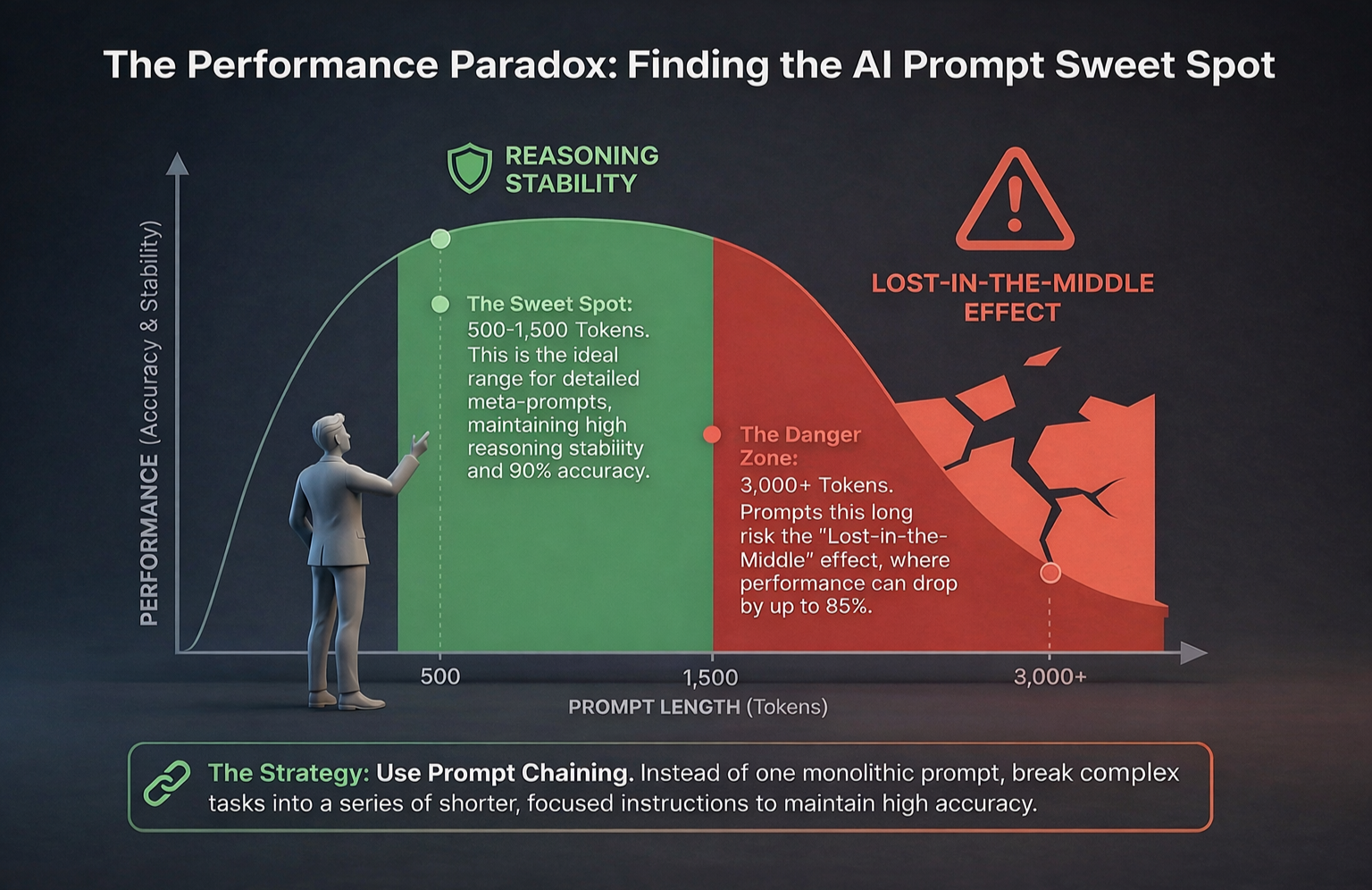
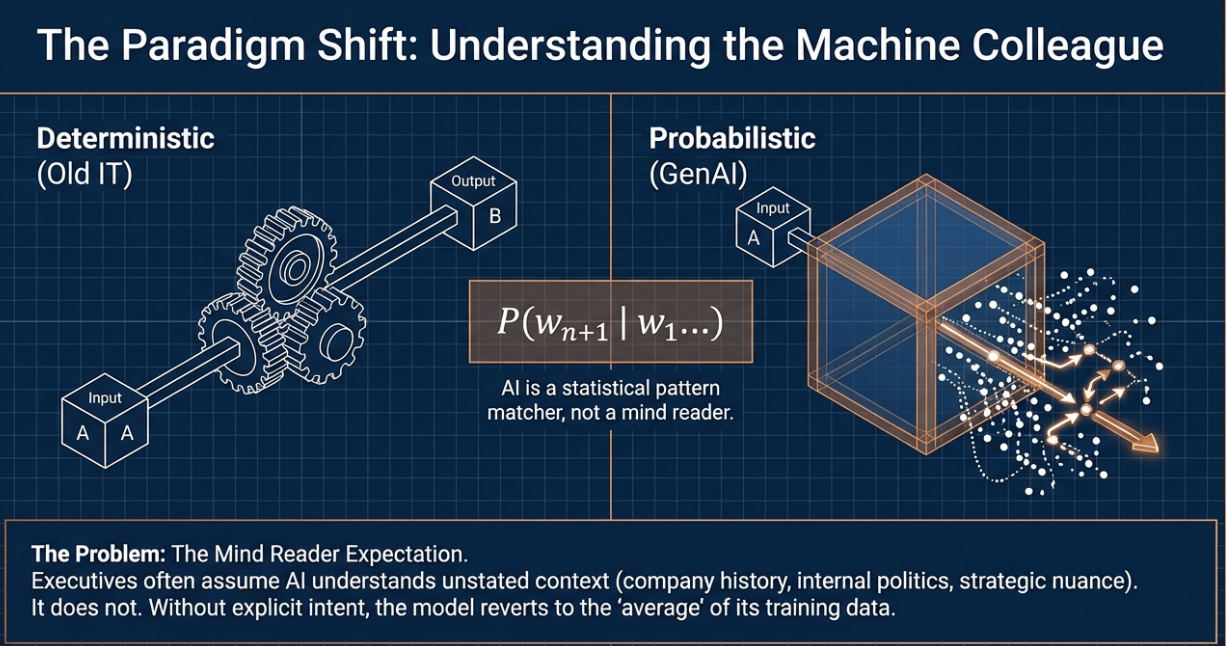
The technical vanguard is moving away from “Few-Shot” prompting (providing many examples) and toward “Meta-Prompting.” This is a structural evolution where we provide the model with a template for “how to think” rather than just a list of “what to think.” This shift is essential because excessive data in a prompt (prompt bloat) often degrades reasoning performance. This “lost in the middle” effect means that even the most powerful models lose focus when forced to parse irrelevant context.
“Instead of providing examples of what to think, a meta-prompt provides a structured template for how to think… enabling LLMs to fill in task-specific details as needed.” — Source: Meta Prompting for AI Systems (arXiv)
The Reputation Risk Multiplier: Why Intangible Capabilities Matter
Reputation is a strategic intangible asset that is notoriously difficult for competitors to replicate, yet easy for an unmonitored AI to destroy. Recent research published by MDPI, which examined 161 listed firms on Bursa Malaysia, confirms that internal capabilities alone do not drive financial success. Instead, the effective management of reputation risk acts as a critical mediator: it is the catalyst that turns a firm’s raw talent and technology into sustained performance.
Firms gain a competitive advantage through this integrative model by:
- Strategic Resource Allocation: Linking AI capabilities directly to the Enterprise Risk Management (ERM) framework.
- Reputation Sensitivity: Using AI to monitor stakeholder trust rather than just operational metrics.
- Proactive Risk Mediation: Identifying specialized hazards, like algorithmic bias, before they manifest in the public domain.
Your content goes here. Edit or remove this text inline or in the module Content settings. You can also style every aspect of this content in the module Design settings and even apply custom CSS to this text in the module Advanced settings.
Predictive Governance for the Malaysian C-Suite
Elite Malaysian directors are no longer satisfied with reactive oversight: they are demanding “predictive governance.” This shift is supported by the 2025 Budget, which allocated MYR 600 million for R&D and an additional MYR 50 million to expand AI-related education, ensuring the talent pipeline matches the technological ambition.
By utilizing techniques like the “ReAct” (Reasoning and Acting) framework, boards can stress-test their strategic moves against real-time competitive intelligence. I have observed that directors who master these frameworks can ask the questions that management might otherwise overlook.
- Accounting Accuracy: Have we flagged any accounting methodology differences or confidence intervals in the projections generated by our AI models?
- Competitive Blind Spots: Can management identify three specific competitive blind spots that our current AI-driven strategic intelligence has uncovered?
- Resource Alignment: How does our current AI talent strategy address the estimated demand for 30,000 professionals by 2030, given our current base of only 3,000?
Human-Centricity and the ASEAN Interoperability Standard
The ASEAN Guide on AI Governance and Ethics is the regional gold standard for interoperability, and Malaysia is leading its practical application. On 27 February 2025, the Digital Consultation Division of the National Digital Department (JDN) launched the Public Sector AI Adaptation Guidelines, providing a clear roadmap for ethical deployment.
- Fairness: Ensuring AI is free from bias and equitable.
- Reliability and Safety: Maintaining human intervention and safety.
- Privacy and Security: Safeguarding personal data.
- Inclusiveness: Benefitting diverse populations without discrimination.
- Transparency: Ensuring processes are explainable and understandable.
- Accountability: Defining clear responsibility for AI outcomes.
- Human Benefit: Enhancing well-being and contributing to society.
“The ASEAN Guide on AI Governance and Ethics aims to empower organisations and governments in the region to design, develop, and deploy traditional AI systems responsibly and increase users’ trust in AI.” — Source: ASEAN Guide on AI Governance and Ethics
Conclusion
Malaysia’s digital trajectory, spearheaded by JDN and the NAIO, suggests that the AI race will not be won by those who write the best prompts, but by those who manage them best. The future of the Malaysian boardroom belongs to those who view governance not as a checklist of restrictions, but as a strategic capability for navigating an increasingly complex silicon landscape.
Is your organisation treating its AI prompts as fleeting conversations, or as the most valuable intellectual property on your balance sheet?
If you require further help understanding & applying AI
If you’d like guided practice instead of doing this alone, I coach professionals one on one, especially those pivoting into AI and feeling overwhelmed by the noise. If that’s relevant, send me a short note about your role and what you’re trying to achieve or overcome, and we can work on it.
0 Comments